
Many Tampa Bay homeowners have architecture worth showing off, yet their nighttime lighting either erases it entirely or lights it unevenly, with hot spots near the fixture and shadows everywhere else. Standard security floodlights can throw off roughly 2,000 lumens of glare, enough to wash out stucco texture and blind anyone standing on the porch.
This guide breaks down what architectural accent lighting actually is, the core techniques professionals use, and how fixture choice and placement change when you're dealing with Florida's heat, humidity, and salt air.
Key Takeaways
- Accent lighting targets specific architectural features instead of flooding a whole property with light
- Match uplighting, grazing, washing, or spotlighting to the surface and material you want to feature
- In coastal Florida, fixture material and IP rating decide how well lights hold up to salt and humidity
- A nighttime demo lets you prove placement and effect before permanent installation
What Is Architectural Accent Lighting?
The Illuminating Engineering Society defines accent lighting as directional light used to emphasize a particular object or surface feature, rather than provide general illumination. That's the key distinction from ambient lighting, which fills a space evenly, and task lighting, which supports a specific activity like reading or cooking.
For a home, that means aiming a controlled beam at a column base, a stone archway, or a gable peak instead of trying to brighten the entire facade at once.
Why targeted light works better than a flat wash:
- Contrast and shadow create depth, making flat surfaces read as three-dimensional
- Selective emphasis draws the eye to the features you actually want noticed
- Uneven, dramatic lighting tends to look intentional; uniform brightness tends to look like a parking lot
Florida properties add a durability constraint. Humidity, salt air, and summer heat can degrade a standard fixture within a couple of seasons. Fixture selection comes later, but it starts at the design stage: the technique you choose shapes the fixture type and placement you'll need.
Core Techniques for Highlighting Architectural Features
Different architectural elements call for different lighting approaches. Here's how the main techniques break down.
Uplighting for Vertical Drama
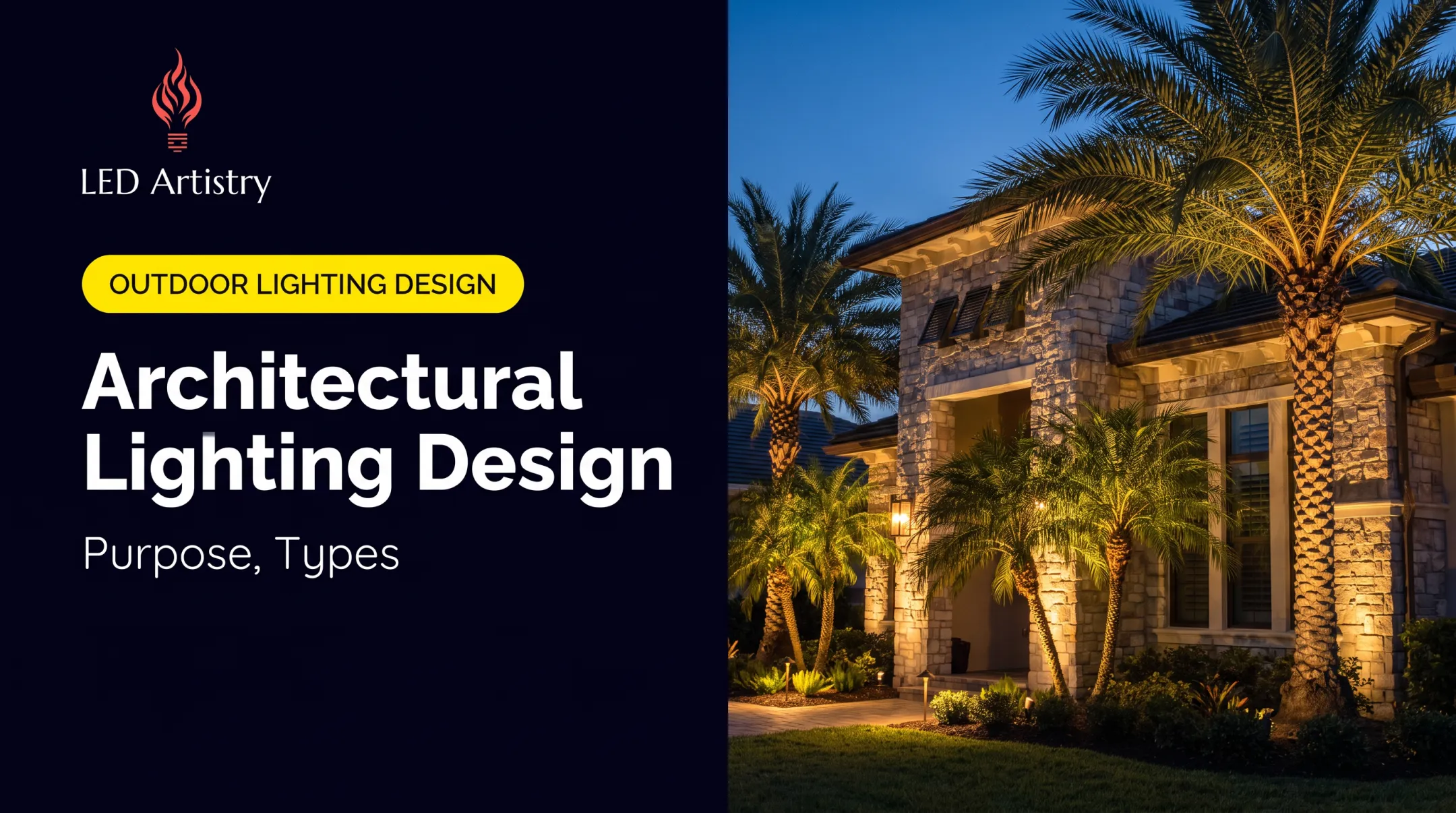
Uplighting is exactly what it sounds like: a fixture at the base of a feature, aimed upward. It's the go-to technique for columns, tall walls, and palm trees, and it's what creates that dramatic silhouette effect against a dark sky.
For tall, slender columns, a narrow 15-degree beam keeps the light focused on the feature instead of spilling onto windows or into the neighbor's yard. Broader elements need a wider spread. On Tampa Bay projects, this is the technique most often used on columns for that same beam control.

Downlighting & Moonlighting for Soft Elegance
Mount a fixture high in a tree or under an eave, aim it down, and you get a soft, dappled pattern that mimics natural moonlight. It's a subtler effect than uplighting, and it works well over:
- Textured entryway walls
- Pool cages and lanai structures
- Walkways where you want ambient glow, not a spotlight
Wall Grazing & Wall Washing for Texture
This is where a lot of homeowners get it wrong. Grazing and washing look similar from a distance, but the placement is completely different.
Grazing places a fixture just 2 to 6 inches from the wall, aimed up at a sharp angle. The light skims the surface and throws deep shadows into every crevice. This is the technique for coquina, stone, coral stone, brick, and heavily textured stucco — anything with a surface you want to feel.
Washing pulls the fixture back to roughly 2-3 feet from the wall for a broader, more even glow. It's the better call for smooth stucco or any flat facade where you want a soft, uniform light rather than dramatic texture.
A common approach on modern Florida homes is a mix — something like a 70/30 split favoring washing, with grazing reserved for a stone accent wall or coquina feature that deserves the extra drama.

Spotlighting Focal Points
A narrow-beam fixture, carefully aimed, isolates a single feature: a fountain, an entry door, a niche in the facade. It's the most surgical of the four techniques, typically using 15-25 degree optics to keep the light exactly where it belongs.
Used together, these techniques do more than look good after dark. The curb-appeal case is real, even without a guaranteed dollar figure. The National Association of REALTORS reports that 92% of REALTORS recommend improving curb appeal before listing a home, and their research lists landscape lighting projects at a representative cost of $6,800.
Lighting won't single-handedly raise your appraisal, but it's clearly part of how buyers and REALTORS think about presentation.
Choosing the Right Fixtures & Placement for Florida Homes
Technique is half the equation. The other half is hardware that survives a Tampa Bay summer.
Low-voltage LED systems are the standard for exterior accent work. LEDs use up to 90% less energy than incandescent bulbs, according to ENERGY STAR, and low-voltage systems are safer to install and maintain around a home's exterior.
Materials matter even more here than technique. Salt air and humidity destroy cheap fixtures fast. Solid brass and copper are preferred for coastal architectural lighting because they resist corrosion and develop a protective patina instead of pitting or peeling.
Marine-grade aluminum and 316-grade stainless hardware fill in where appropriate. Conventional powder-coated aluminum, by contrast, can start bubbling or corroding within 18-24 months near the coast.
Look for fixtures rated IP67 or higher — dust-tight, and protected against temporary submersion. That rating matters more in Florida than almost anywhere in the country.
Placement guidelines:
| Technique | Distance from surface | Beam angle |
|---|---|---|
| Grazing | 2-6 inches | Sharp upward angle |
| Washing | 2-3 feet | Broad, even spread |
| Spotlighting | Varies by feature | 15-25 degrees |
| Uplighting (columns) | Fixture base | 15 degrees for narrow features |
Avoid pointing any fixture directly at glass or pool tile. Reflective glare undoes the whole effect.
For warmth, 2700K-3000K is the standard color temperature for architectural accent lighting. Warmer 2700K tends to suit stone, wood, and stucco; 3000K works better against gray stone, slate, or steel accents.

Planning Your Accent Lighting Layout
Before a single fixture goes in the ground, walk your property and identify 3-5 standout features worth highlighting. Not every column, arch, or texture needs a light — the goal is emphasis, not saturation.
Once you've picked your targets, test before you commit. A nighttime demo is the surest way to validate those choices. LED Artistry brings temporary, battery-powered fixtures to the property and sets them up after dark so homeowners can see the real effect, not a rendering.
What typically happens during a demo:
- Reposition fixtures in real time, sometimes by just a few inches to kill glare
- Adjust beam spread and intensity on the spot
- Compare warm 2700K directly against 3000K
- Fine-tune based on what looks right at night, not on paper
Don't design your accent lighting in isolation. Layer it with pathway and landscape lighting so the whole property reads as one cohesive design instead of a house lit up next to a dark yard.
Why Professional Installation & Support Matter
DIY exterior electrical work in Florida carries real risk. Humidity accelerates wiring failures, and outdoor outlets on qualifying circuits require GFCI protection under the Florida Building Code. Add storm exposure and salt-air corrosion, and a poorly installed system can fail within a season or two.
Professional installation typically includes:
- Voltage-drop engineering: sizing transformers with a buffer so far-end fixtures don't dim
- Watertight connections: critical in a climate this humid
- Astronomical timers: adjusting automatically for Florida's shifting sunset times
- Zoned dimming: so your pool, lanai, and architectural accents run independently

LED Artistry backs its installs with a 20-year warranty and ongoing maintenance. Coastal properties often need semi-annual inspections to clean salt deposits and re-check connections.
As a family-owned, Tampa Bay-based team with over 12 years designing custom architectural and landscape lighting, the team has seen firsthand what survives a Florida summer and what doesn't.
Frequently Asked Questions
What is architectural accent lighting?
It's directional lighting used to emphasize a specific architectural feature (a column, archway, or textured wall) rather than provide general illumination. The goal is contrast and depth, not brightness across the whole facade.
What are examples of architectural accent lighting?
Common examples include uplighting on columns, grazing on stone or coquina walls, spotlighting on entryways, and cove or moonlighting effects over patios and pool cages.
What is the difference between accent lighting and ambient lighting?
Accent lighting focuses on highlighting a specific feature with a directional beam. Ambient lighting provides even, general illumination across a room or property without singling anything out.
How much does architectural accent lighting cost?
A standard 10-15 fixture system typically runs $2,500 to $5,000, while larger estates or complex layouts can reach $15,000 or more. Cost depends on fixture count, home size, and wiring complexity. A free consultation gets you a specific number.
Can accent lighting improve home value or curb appeal?
There's no guaranteed dollar increase, but REALTORS often recommend improving curb appeal before listing, and landscape lighting is a common part of that conversation. It's how a home presents after dark, even without a fixed return figure.
How do I maintain outdoor architectural lighting fixtures?
Clean lenses and housings periodically to remove salt and hard-water deposits, check wiring connections and voltage, and adjust fixtures as landscaping grows. A professional maintenance plan, typically $180-$350 annually, handles this without you climbing a ladder in July.