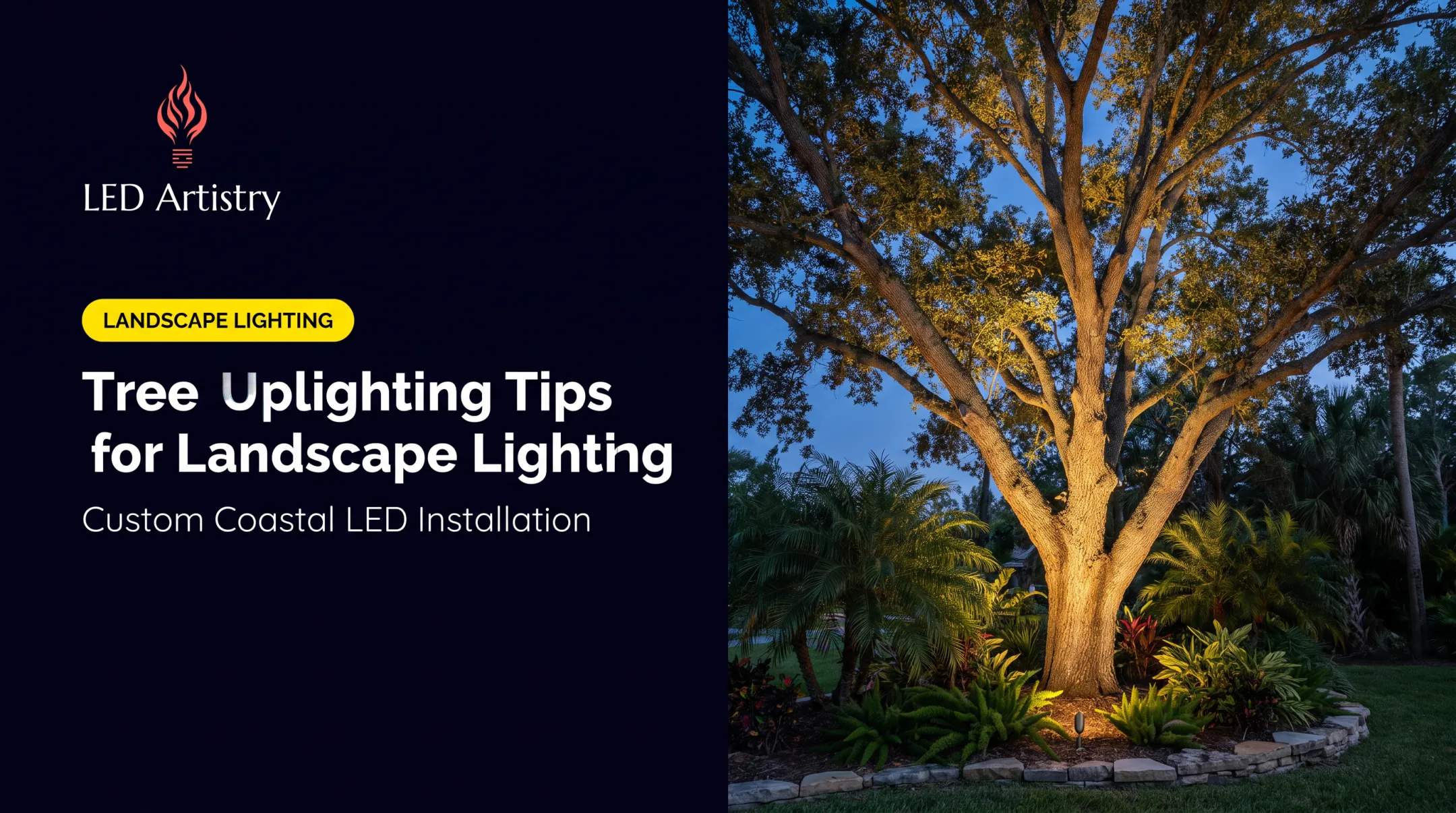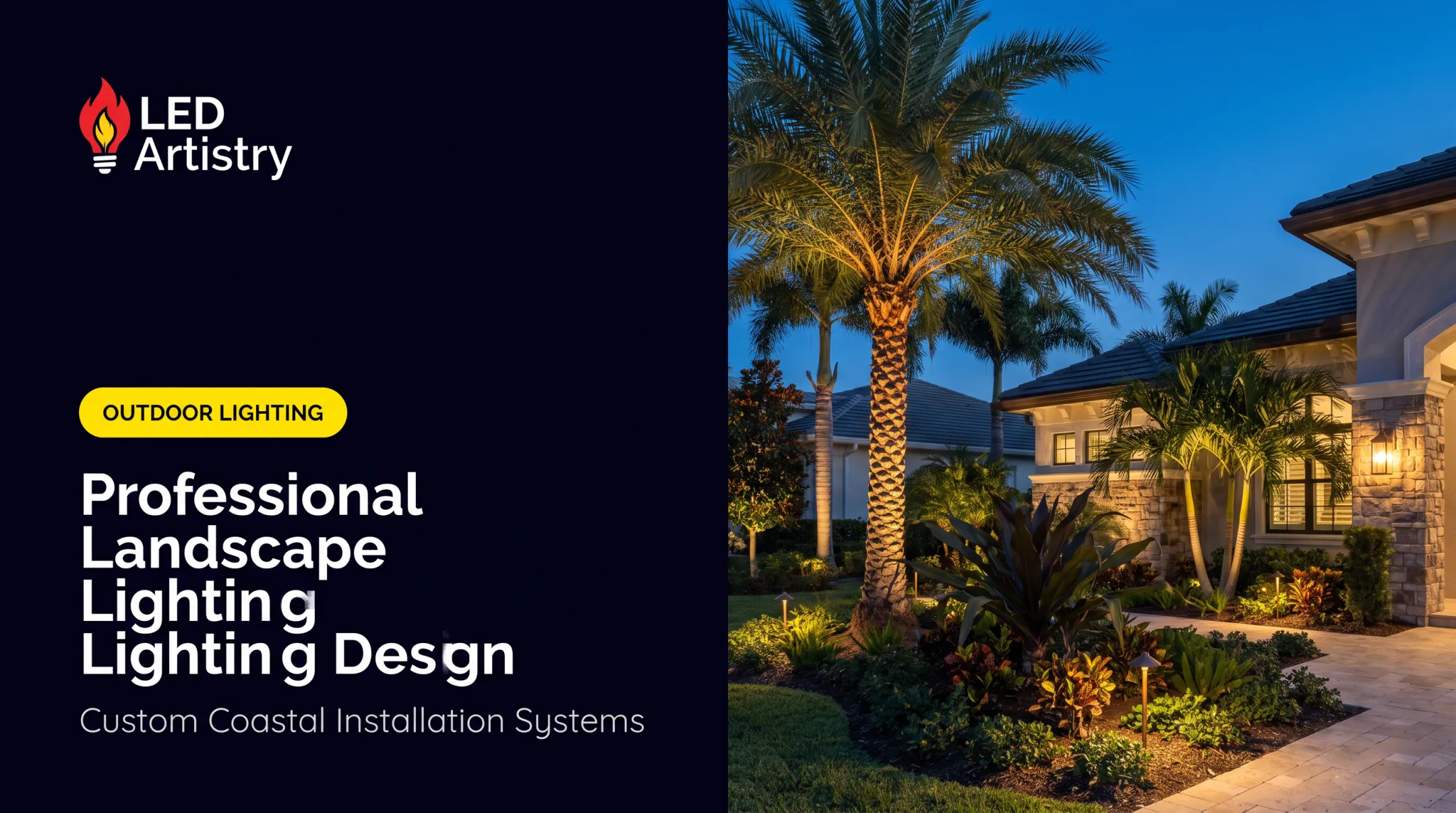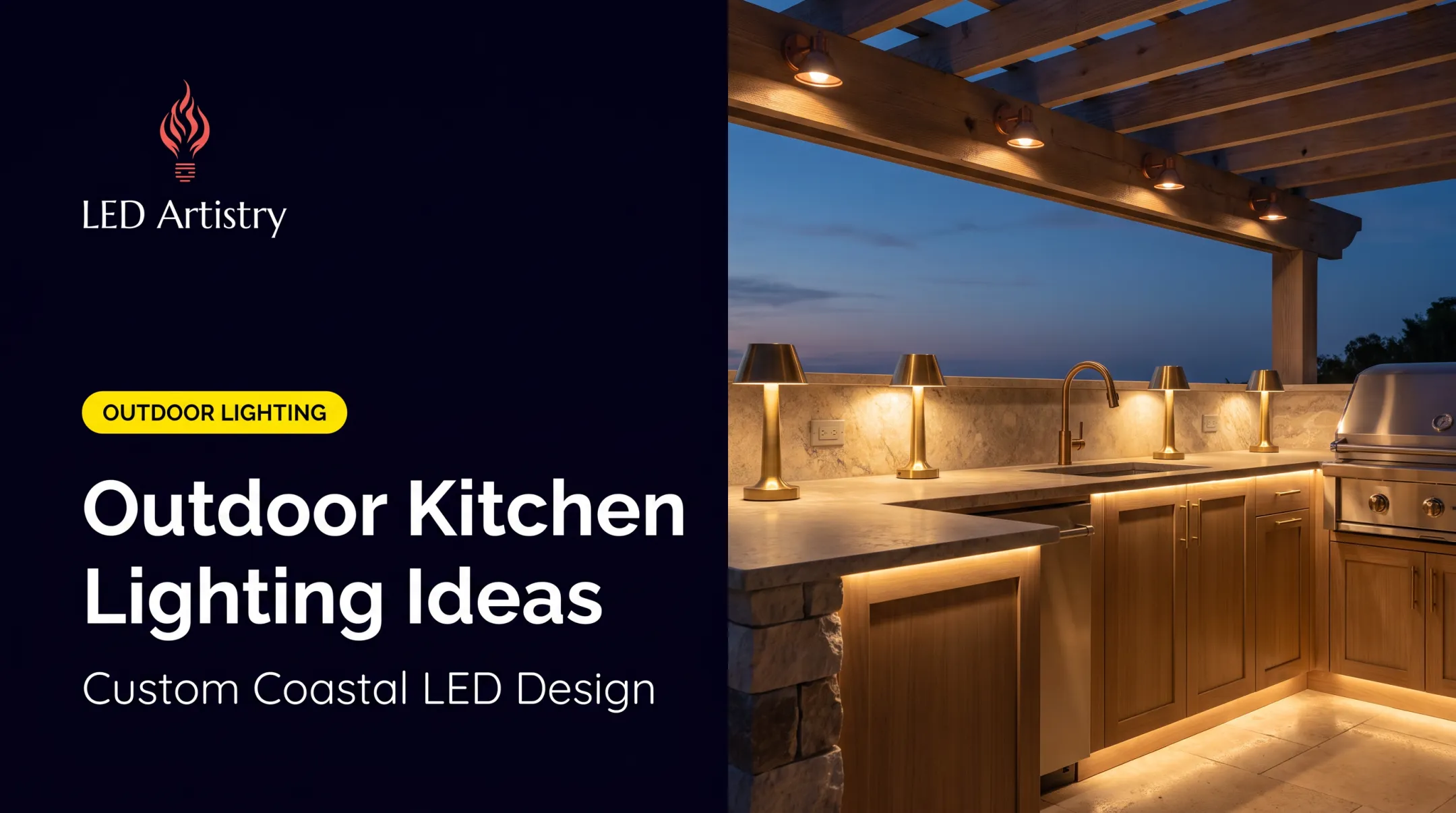

Homeowners often assume they have to pick a lane, uplighting or downlighting, when really the question is where each one belongs on your property. The wrong choice affects more than looks. It shapes safety near your pool, security around entry points, and how much you actually use your patio or dock after dark.
This guide breaks down both techniques so you can figure out what your house actually needs.
TL;DR
- Uplighting shines from ground level upward to highlight trees, columns, and architectural features
- Downlighting mounts higher and casts light down for broader, softer illumination on walkways and patios
- Uplighting creates drama; downlighting creates safety and a natural "moonlight" feel
- Most professionally designed properties layer both instead of choosing one
- The right mix depends on the feature's height, its purpose, and your desired mood
Uplighting vs Downlighting: Quick Comparison
| Factor | Uplighting | Downlighting |
|---|---|---|
| Primary purpose | Highlights vertical features, creates focal points | Illuminates broad areas, improves visibility |
| Fixture placement | Ground-mounted or in-ground well lights | Mounted high (eaves, trees, walls) |
| Best for | Trees, columns, statues, textured walls | Walkways, patios, driveways, low plantings |
| Effect | Dramatic, contrast-heavy, shadow-play | Soft, natural, "moonlighting" ambiance |
| Florida climate factor | Needs sealed housings against irrigation, humidity, sandy soil | Needs corrosion-resistant metals for salt air at height |
Both categories share one non-negotiable in coastal Florida: sealed, corrosion-resistant construction. Ground fixtures sit inches from sprinklers and mulch beds. Elevated fixtures spend years exposed to salt-laden air. Neither survives long on cheap hardware.
What Is Uplighting?
Uplighting places fixtures at or near ground level and points them upward toward a feature worth noticing. For Tampa Bay homes, that usually means palm trees, stucco columns, or textured facade details that look flat and forgettable without it.
Done well, uplighting:
- Adds depth to a flat exterior wall or entry column
- Creates a focal point that draws the eye where you want it
- Doubles as extra security lighting around entry points, eliminating dark pockets near doors
Two main fixture types handle this job:
- Directional spotlights sit slightly above grade and aim at a specific target, like a column or flagpole
- In-ground well lights sit flush with pavers or turf, making them the better pick near pool decks where a protruding fixture becomes a trip hazard or eyesore
Use Cases of Uplighting
Uplighting earns its place on Tampa Bay properties with palm trees, stucco columns, pool cages, or waterfront architectural details that benefit from a vertical accent. Common placements include:
- Porch columns and entry pillars
- Garden statuary and flagpoles
- Dock pilings and pier posts
One caveat for waterfront and coastal properties: standard fixtures don't hold up. Marine-grade, corrosion-resistant hardware—solid brass, copper, or 316 stainless steel—is essential.
LED Artistry specifies fixtures rated IP67 or IP68, meaning they're dust-tight and can handle temporary or continuous submersion depending on placement. Those systems pair sealed LED modules with gel-filled connectors to keep salt air and moisture out.

What Is Downlighting?
Downlighting mounts fixtures at height, on eaves, in tree canopies, or along pergolas, and directs light down toward the ground. This is the technique that makes your outdoor living space usable after dark, not just visible from the street.
Core benefits:
- Improves safety on walkways and driveways
- Reduces trip hazards near pools and docks
- Creates a warm, inviting glow for entertaining
One popular variation is moonlighting, where fixtures are mounted high in mature tree canopies, typically 20 to 30 feet up, and aimed downward to mimic natural light filtering through branches. The fixtures and wiring stay concealed within the canopy so the light source itself stays invisible; you just see the dappled effect on the ground below.
Because trees grow, this installation needs slack built in from day one. LED Artistry typically leaves 3 to 5 feet of extra wire at each fixture, with plans to reposition them further out over 2 to 4 years as the canopy expands.

Use Cases of Downlighting
Downlighting fits anywhere broad, even coverage matters more than drama:
- Patios, pool decks, and outdoor kitchens
- Paths connecting the house to a dock or seawall
- HOA entrances, restaurant patios, and hotel walkways
Beyond ambiance, the practical payoff on those same paths and decks is safety. Hard data mostly comes from public roadways rather than private properties, but the Federal Highway Administration found well-designed intersection lighting is linked to 33-38% fewer nighttime crashes, and adequate lighting at pedestrian crossings correlates with 42% fewer nighttime pedestrian-injury crashes.
Those figures are from roadway studies, not backyard patios—but the principle still holds: better visibility means fewer accidents.
Uplighting vs Downlighting: What's Better for Your House?
There's no universal winner here. The right call depends on three things:
- The feature's height: Tall, narrow elements (columns, palms, statues) suit uplighting; broad, low areas (patios, paths) suit downlighting
- Its role: Is this spot about safety and function, or aesthetics and focal points?
- Your property's goals: Curb appeal, entertaining, security—or all three
Quick rule of thumb: Choose uplighting to spotlight trees, columns, or waterfront features. Choose downlighting for pathways, patios, and general area safety.
Ask most professional lighting designers and they'll tell you the same thing: layering both is almost always the better answer. Uplighting supplies the drama. Downlighting supplies the function. Together, they make a property feel finished and intentional.
If you're not sure where each technique belongs on your house, a free nighttime demonstration settles it.
LED Artistry brings temporary fixtures to your property after dark and adjusts placement, brightness, and beam angle in real time—so you decide from what you see, not guesswork.
Real-World Application: Choosing the Right Layout for Your Property
Picture a typical Tampa Bay waterfront home: mature palms flanking the entry, stucco columns framing the front porch, a pool deck out back, and a dock leading to the water. Done right, that property layers both techniques:
- Uplighting on palms and columns for vertical drama
- Downlighting along the dock walkway and pool deck for safe, even footing after dark

The problem most homeowners run into is guesswork. DIY placement often means fixtures aimed too high, too bright, or in the wrong spot entirely, resulting in glare over the pool or harsh shadows across the patio. Because outdoor lighting doesn't show its true character until it's dark, mistakes are hard to catch until the system is already installed.
A professional nighttime demo removes that risk. Instead of guessing where a well light should sit relative to a palm's canopy, or how high a downlight needs to be for even patio coverage, you see it live.
LED Artistry's designers test uplighting on your columns and downlighting over your dock walkway in the same evening, adjusting beam spread and color temperature (2700K warm versus 3000K, for instance) until it looks right—not just on paper.
There's a financial upside here too. According to the National Association of Realtors, landscape lighting projects recover an estimated 59% of their cost at resale, and 97% of Realtors consider curb appeal important in attracting buyers, with the majority calling it "very important". That's a strong signal that a thoughtfully layered system pays dividends beyond just nightly enjoyment.
The takeaway: the right mix is specific to your property's trees, hardscape, and architecture. Testing it live, before committing, is what separates a lighting plan that works from one you'll want to redo in a year.
Ready to see it on your own house? Call (813) 999-6255 to schedule LED Artistry's free nighttime demo and watch uplighting and downlighting placements come to life before you decide on anything.
Conclusion
Uplighting and downlighting work best as a pair. Each solves a different problem on the same property. Uplighting turns a flat facade or bare palm trunk into a focal point. Downlighting turns a dark patio or dock walkway into a space you'll actually use after sunset.
For Tampa Bay homeowners, the payoff is practical: better curb appeal, safer paths around the pool and dock, and more hours outdoors after dark. That result comes from a custom plan built for Florida's salt air and humidity, not a one-size-fits-all kit from a big-box store. A free nighttime demo on your property is often the fastest way to see which mix of both techniques fits your home.
Frequently Asked Questions
When should you use uplighting vs downlighting for an exterior house?
Uplighting suits vertical features like columns, palms, and statues, where you want drama and focal points. Downlighting suits walkways, patios, and pool decks, where safety and even visibility matter more.
What is the difference between uplighting and downlighting?
Uplighting fixtures sit at ground level and point up, creating a dramatic, shadow-heavy effect. Downlighting fixtures mount higher and point down, producing a soft, natural glow similar to moonlight.
What is the best type of lighting for an exterior house?
Most homes benefit from a layered combination rather than committing to just one technique. Uplighting handles focal points while downlighting handles safety and ambiance across the rest of the property.
Are uplights worth it for exterior houses?
Yes, for both curb appeal and security. Uplighting highlights architectural features that would otherwise disappear at night and reduces the dark corners and shadows where trespassers could hide.
Where should you place uplights on an exterior house?
Ideal spots include entry columns, mature trees like palms, textured stucco walls, and statuary or flagpoles. These are vertical, eye-catching features that benefit most from upward light.
Can downlights be used as uplights?
Some adjustable fixtures with interchangeable optics can serve double duty, but dedicated fixtures built for each specific angle and effect typically perform better and last longer in Florida's climate.