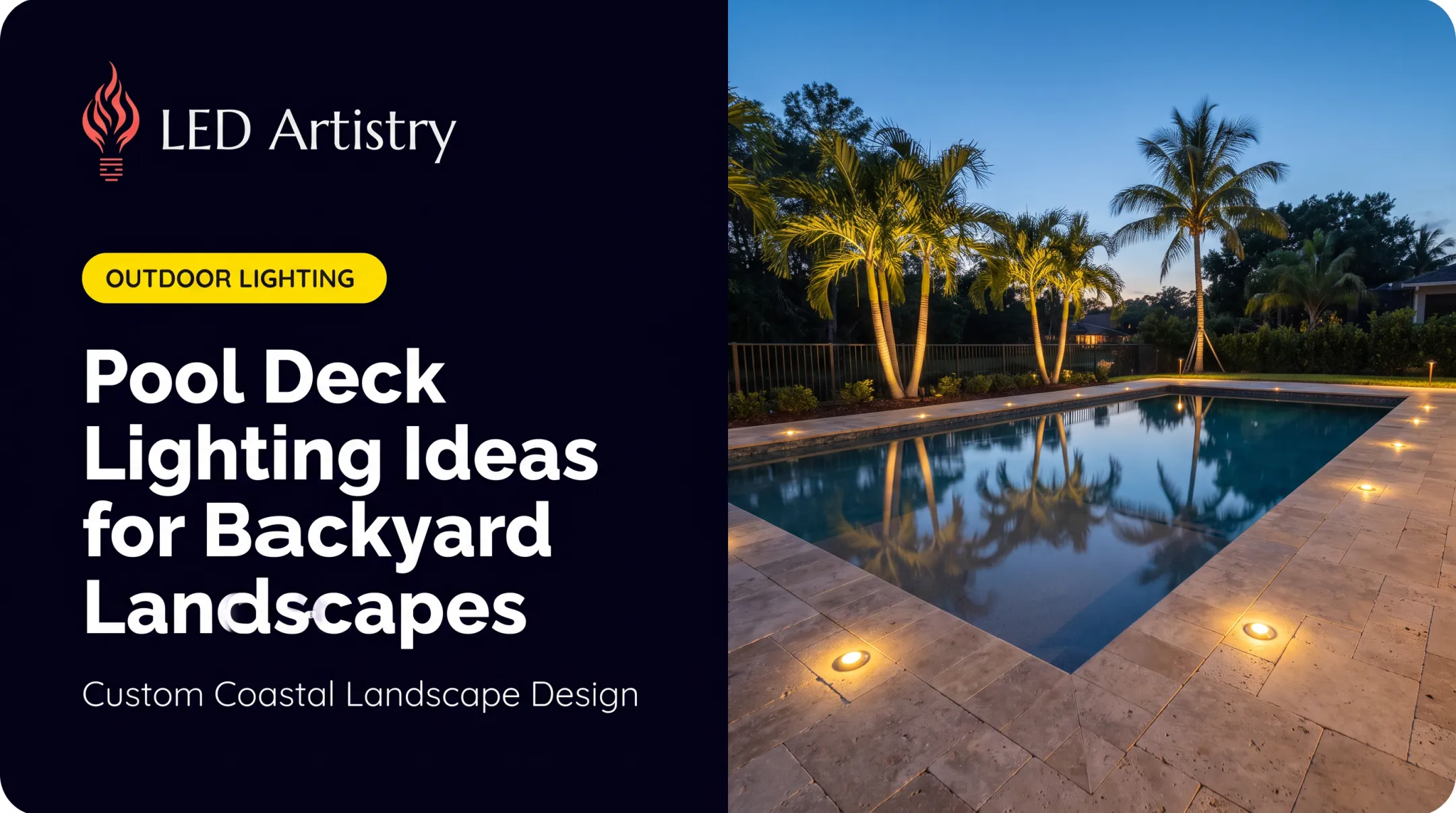

Beyond looks, lighting serves a second job: keeping swimmers, kids, and pets safe once natural light disappears. Steps, edges, and water depth all become harder to judge in the dark.
This guide walks through deck lighting ideas, underwater options, budget-friendly picks for above-ground pools, retrofitting existing pools, and the electrical safety rules that matter most. We'll also pull in some real-world insight from LED Artistry's Tampa Bay lighting projects along the way.
Key Takeaways
- Layer underwater, deck, and landscape lighting for a cohesive nighttime look
- Low-voltage LED systems beat halogen on efficiency, lifespan, and safety
- Existing pools can be retrofitted with lighting without draining or major renovation
- GFCI protection and local electrical code compliance aren't optional
- A nighttime demo lets you preview results before signing off on a design
Creative Pool Deck and Surrounding Area Lighting Ideas
Moonlighting and Uplighting for a Resort Feel
Moonlighting mimics natural light filtering through leaves. Mount fixtures high in a tree and aim a downward beam through the branches so the canopy casts dappled shadows across the pool deck, a technique outlined in Kichler's landscape lighting guide.
LED Artistry typically mounts these fixtures 20-30 feet up in mature Live Oaks or Royal Palms around Tampa Bay properties, since a fuller canopy produces a more convincing filtered-light effect.
Uplighting works from ground level upward to highlight:
- Palm trunks and canopies (narrow 10-15 degree spots)
- Hedges and broader landscaping (wider wash beams)
- Architectural columns and textured walls near the pool
Steps, Water Features, and Shaded Areas
Step and stair lighting on a pool deck does double duty. It's a design accent, but it also marks changes in elevation that are easy to miss at night. LED Artistry builds these as low-profile, 12-volt fixtures integrated directly into risers and rails.
For water features, technique matters more than fixture count:
- Fountains: one well-placed spotlight catches the spray and creates shimmer
- Waterfalls: a grazing technique places the light close to the surface, emphasizing stone texture and moving water
Warm-white 2700K is the better choice for waterfalls because it flatters stone and foliage.
Shaded seating areas (pergolas, lanais, cabana structures) often get bistro string lighting. LED Artistry builds these on stainless-steel tension cables with UV-resistant wiring and IP67-rated weather-sealed sockets, instead of draping standard patio strands that sag and fail faster in coastal wind.
Undercap lighting on seating walls and fire pit benches rounds out the deck. It throws a soft, glare-free glow without shining directly into anyone's eyes.

In-Water and Underwater Pool Lighting Options
LED vs. Halogen: What the Numbers Show
Underwater LED fixtures are the most popular in-pool lighting choice, and the efficiency gap with older technology is significant. According to Jandy's pool lighting product page, LED fixtures use 18-65 watts compared to 100-500 watt incandescent bulbs for equivalent brightness (up to 87% less energy) and last roughly 10 times longer.
| Lighting Type | Power Draw | Relative Lifespan | Notes |
|---|---|---|---|
| LED | 18-65W | Up to 10x longer | Lowest energy use, color-changing available |
| Halogen/Incandescent | 100-500W | Baseline | Higher heat, shorter bulb life |
| Fiber-optic | Varies | Long | Higher retrofit cost |
| Solar | Low | Moderate | No wiring; limited brightness for primary pool use |

Color-Changing and Smart Control
Modern underwater systems go beyond a single white glow. RGBW fixtures shift between vibrant colors and warm white, controllable through a smartphone app. LED Artistry designs low-voltage systems that integrate with smart-home platforms such as Lutron and Control4, so you can set a pool-party scene or dim the water for a quiet evening swim from your phone or keypad.
Built for Florida Conditions
Salt air and humidity destroy cheap fixtures fast. LED Artistry specifies gear built for coastal pool environments:
- Solid brass, copper, and marine-grade aluminum for humidity and salt-spray exposure
- IP67-rated fixtures for wet locations, splash zones, and pool-cage perimeter lighting
- Exclusively 12-volt low-voltage systems with UL-listed wet-location components
Perimeter LED strip lighting along the pool edge adds a sharp silhouette without submersion, layering cleanly with in-water fixtures for depth after dark.

Budget-Friendly and Above-Ground Pool Lighting Ideas
Not every backyard needs a hardwired lighting system. If you want glow without permanent wiring, start with simple drop-in and plug-free options:
- Floating solar LED lights: a two-pack of TECHKO Solar Floating LED Pool Lights runs about $54 and holds a charge for 12-plus hours
- Floating RGB LED balls: four-packs with remote control usually cost around $56
- Submersible battery lights: no install and no wiring—drop them in and reposition as needed
For above-ground pools specifically:
- Suction-cup or magnetic LED lights mount on the wall (Intex’s magnetic model covers pools up to 24 feet, about $75)
- Freestanding floodlights aimed at the water add brightness for night swims and gatherings
- String lights along the top rail create soft ambient glow around the perimeter
Solar landscape stake lights around the pool edge add path visibility and a finished look for little cost, with no electrician required.
Can You Add Lights to an Existing Pool?
Yes. Retrofitting is common, and it doesn't require draining the pool or tearing up landscaping — but underwater fixture work typically needs a professional.
Cost expectations (per fixture, per Angi's 2026 cost guide):
- Incandescent replacement: $450-$650
- LED replacement: $700-$1,500
- Fiber-optic replacement: $1,300-$1,700
- Overall average across technologies: $625
Angi also notes labor typically runs $50-$100 per hour, with wiring updates ranging $350-$4,000 depending on the property's existing infrastructure.
Lower-cost alternatives skip the electrical work entirely. Solar or battery-powered submersible lights avoid trenching altogether, trading some brightness and control for a same-day install.
For a permanent upgrade without opening the pool shell, enclosure and deck lighting is another retrofit path.
How LED Artistry Handles Retrofits
For pool cages and lanais, LED Artistry runs 12-volt wiring inside the hollow aluminum beams of the existing enclosure rather than trenching through the yard. Fixtures attach to the beams with non-invasive mounts, preserving screen tension and the enclosure's clean lines.
The process:
- Assess electrical infrastructure and cage structural condition
- Run a free nighttime demo with temporary fixtures for approval
- Install fixtures and route wiring inside existing channels
- Protect landscaping and mesh, then test and walk through the finished system
LED Artistry reports retrofitting roughly 95% of Tampa Bay lanais it worked on last year with zero mesh damage, and has enhanced more than 500 existing pool cages since 2012.

Pool Lighting Safety and Electrical Requirements
Pool lighting isn't a place to cut corners. A few non-negotiable rules:
- Low voltage near water. Most underwater and adjacent fixtures run on 12-volt systems to reduce shock risk.
- Depth placement. Under the NEC, underwater luminaires must sit 4 to 18 inches below normal water level (NEC Article 680 overview).
- GFCI protection. Any 120-volt circuit feeding pool lighting or nearby receptacles requires GFCI protection.
- Overhead string lights. Use outdoor-rated damp-location fixtures and keep them clear of direct water contact.
Codes vary by jurisdiction, and the local authority having jurisdiction always has final say. For anything wired near water, hire a licensed electrician or certified lighting professional—that is standard practice, not a nice-to-have.
Previewing the layout before permanent wiring also reduces rework risk. LED Artistry's free nighttime demonstration places temporary fixtures so homeowners can see how a design reads against the pool cage, landscaping, and water before installation.
Frequently Asked Questions
What are some affordable pool lighting options?
Solar floating lights, floating LED balls, and battery-powered submersible lights are the cheapest entry points. Most run $50-$75 for multi-packs, and none require electrical work.
Can you add lights to an existing pool?
Yes. Retrofitting typically costs $450-$1,700 per fixture depending on technology, though solar or battery-powered submersibles offer a no-dig, lower-cost alternative.
What type of lighting is best for a swimming pool?
LED is the strongest choice for most pools. It uses up to 87% less energy than incandescent, lasts roughly 10 times longer, and supports color-changing options halogen can't match.
What are some good lights for an above-ground pool?
Suction-cup or magnetic LED lights, standalone floodlights, and solar landscape stake lights around the perimeter all work well without needing an electrician.
Is pool lighting low voltage, and what are the electrical safety requirements?
Most pool lighting runs on 12-volt low-voltage systems to minimize shock risk. Any 120-volt circuit near the pool must have GFCI protection and meet local electrical code requirements.
Is it safe to hang lights over a pool?
Yes, as long as the fixtures are outdoor-rated for damp locations and mounted away from direct water contact. Proper installation and code compliance are what make it safe, not the string lights themselves.