
Homeowners across Tampa Bay increasingly want that same atmosphere in their own backyards, especially around pools, patios, and waterfront lots. The good news is that resort-caliber lighting doesn't require a resort budget or a resort's maintenance crew.
This guide covers what actually makes lighting feel "resort-style," the zones worth prioritizing, the design principles pros rely on, and how to choose fixtures that survive Florida's climate. We'll also cover how LED Artistry approaches this work, including a free nighttime demo that shows you the effect before you commit.
Key Takeaways
- Layer ambient, accent, and task light—skip the single bright wash
- Put pools, water features, and outdoor living zones first for guest impact
- Spec marine-grade, low-voltage LEDs for Florida humidity and salt air
- Lock the plan with professional design and a nighttime demo before you spend
What Makes Lighting Feel "Resort-Style"
Resorts rarely rely on one big floodlight. Instead, they blend several soft layers of brightness, use warm color temperatures, and let shadows fall where they naturally would. The result feels intentional rather than lit-up.
Boca Lighting, a hospitality lighting specialist, frames this as three coordinated layers: ambient, accent, and task lighting working together to shape comfort and highlight architecture. Peer-reviewed hotel research backs this up indoors, too. A study on hotel lobby lighting found that color temperature and brightness levels directly affected guests' visual comfort, and that low illumination increased visual fatigue.
That's the opposite of typical residential floodlighting, which tends to blast a single harsh, cool-white beam across the whole yard. It's bright, but it flattens everything and kills the mood.
Homeowners notice the difference. The 2023 NAR/NALP Remodeling Impact Report gave landscape lighting a Joy Score of 10 out of 10 and an estimated 59% cost recovery, among the highest satisfaction scores of any outdoor home feature.
Ambient vs. Accent vs. Task Lighting
Each layer plays a distinct role in a landscape:
- Ambient — soft, overall glow along a walking path or across a patio floor
- Accent — focused uplighting on a palm tree trunk, column, or garden feature
- Task — brighter, functional light over an outdoor kitchen counter or grill station
Skip any one layer and the design feels incomplete: too dark to navigate, too flat to admire, or too bright to relax in. Design-first installers such as LED Artistry use this same three-layer mix so a home patio, pool deck, or entry reads with the same intentional glow guests expect at a resort.

Key Zones to Light for a Resort-Style Backyard
Not every square foot of your property needs equal attention. A handful of zones create most of the resort effect.
Pool and Spa Areas
The goal is moonlighting, not glare. LED Artistry typically mounts high-output fixtures 20 to 30 feet up in mature tree canopies, aiming down through the branches so foliage filters the beam into dappled shadows across the deck.
For screened pool cages, linear bar lights along the overhead beams provide even downlighting without fixture glare bouncing off the water.

Water Features and Waterfalls
Lighting the water directly creates a blinding hot spot. Instead, use grazing: place a light near the base of a waterfall and aim it across the rock face to reveal texture and shadow. A well-aimed spotlight can catch the spray for shimmer without floodlighting the pond itself.
Pathways, Patios, and Outdoor Living Spaces
Path lights, step lights, and bollards keep foot traffic safe after dark. The IES LP-2 pedestrian lighting standard emphasizes revealing terrain and edges while avoiding glare: visibility over brightness.
Architectural and Landscape Accents
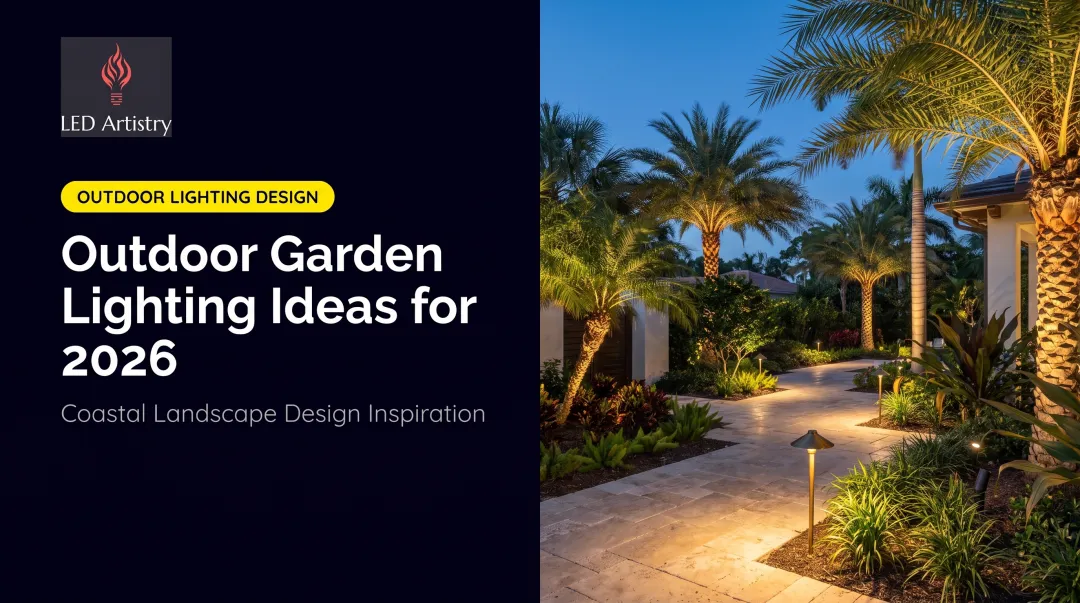
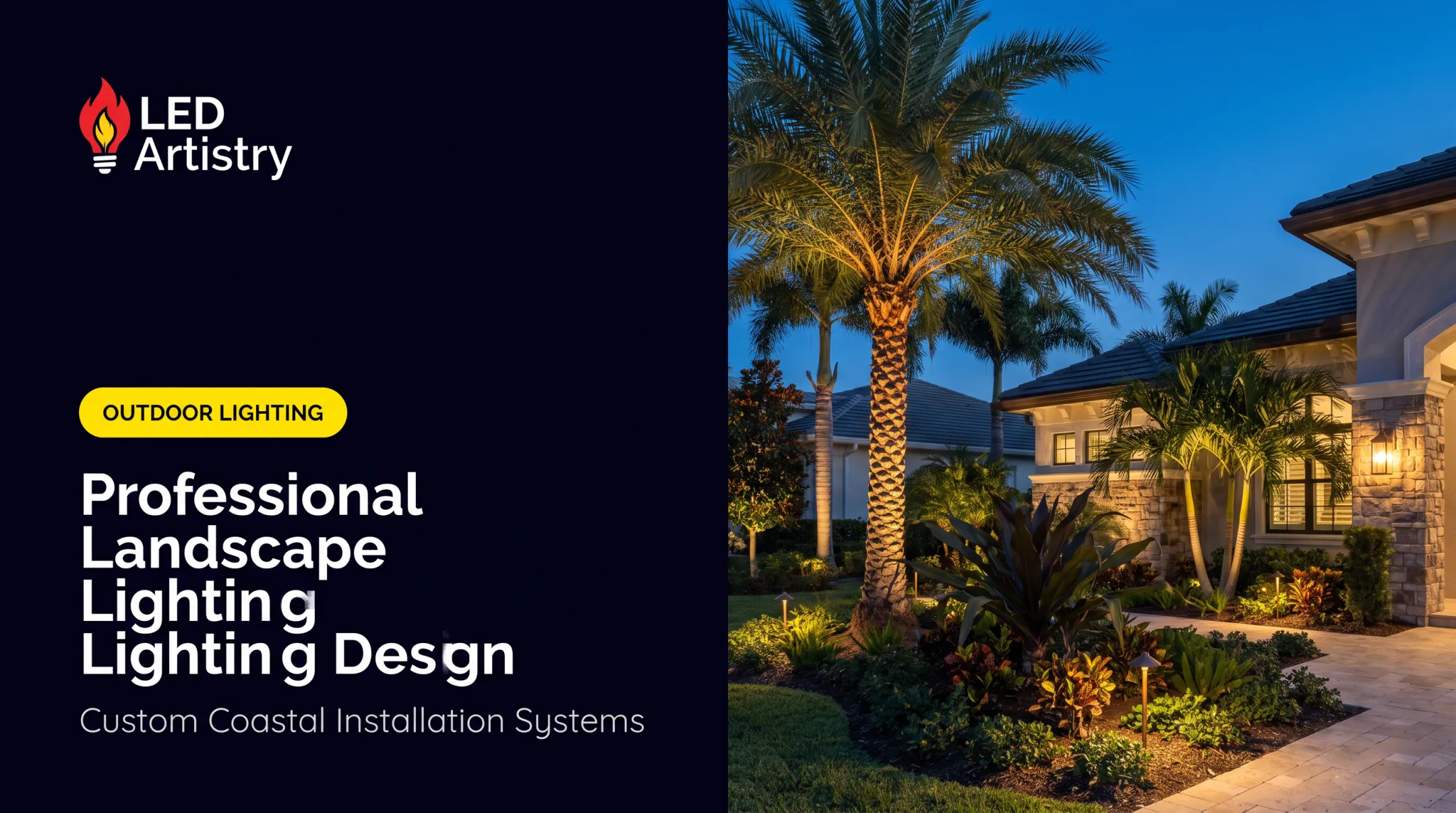
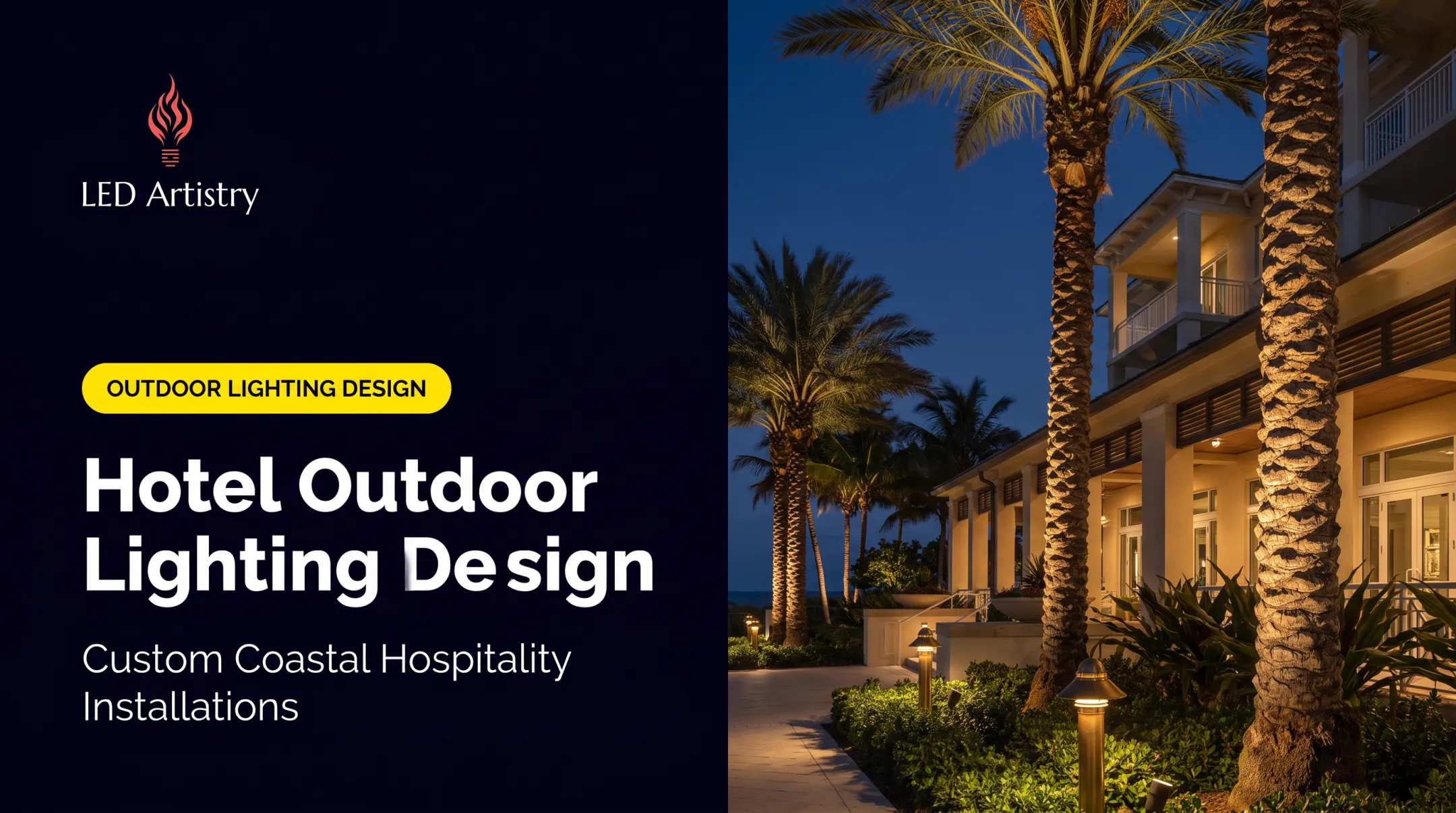
Uplighting on palm trunks, columns, and facades adds depth after dark, turning flat daytime features into layered nighttime focal points.
Docks, Seawalls, and Waterfront Areas
Waterfront properties need fixtures built for direct salt exposure (more on that below). Where FWC sea turtle guidelines apply, fixtures should stay low, use long-wavelength amber light, and remain fully shielded from the beach.
Descriptions only go so far. LED Artistry's free nighttime demo lets homeowners walk their own property after dark with temporary fixtures in place, so the effect is real before any wiring goes into the ground.
Design Principles That Create a True Resort Atmosphere
Great resort lighting comes from composition and electrical discipline working together, not from fixture choice alone. Composition and balance. Lighting only the "highlight" features and leaving everything else pitch black creates a spotty, disjointed look. The dark space between fixtures matters as much as the lit space. Soft ambient fill helps the eye read the whole scene as connected. Voltage drop and system planning. On larger properties, wire gauge and transformer sizing determine whether fixtures at the far end of a run stay bright or slowly dim out. Practical standards:
- 12-gauge wire handles runs up to roughly 100 feet at 100 watts or less
- 10-gauge wire is needed for runs beyond 150 feet or heavier loads
- Transformers should run at no more than 80% capacity, with 20-30% headroom for future additions Smart lighting controls. App-based systems (Lutron, Control4, and similar platforms) let you dim specific zones to 20% for a quiet dinner or bring everything to 100% for a pool party. Astronomical timers also adjust automatically as sunset times shift through the year. Avoiding overlighting. More fixtures aren't automatically better. Extra brightness erases shadow and depth, which is what makes resort lighting feel relaxed instead of like a parking lot.

Choosing Durable Fixtures for Florida's Climate
Standard big-box landscape fixtures weren't built for Florida resort grounds. Humidity, UV, and coastal salt air corrode cheap aluminum housings within a few seasons—especially around pools, pathways, and waterfront guest areas.
Low-voltage, marine-grade LED fixtures solve this. They run cooler, use less energy, and use materials built for coastal conditions—not just splash resistance.
When comparing installers, ask about:
- Wet-location listing — confirms a fixture is safety-rated for direct water contact, not just splash resistance
- IP67 rating — dust-tight housing with protection against temporary immersion
- Corrosion-resistant materials — solid brass, copper, 316 stainless, or marine-grade aluminum that resist chloride pitting better than standard aluminum
LED Artistry specifies IP67-rated, UL-listed wet-location fixtures in solid brass, copper, and marine-grade metals suited to coastal Florida. Brass and copper develop a protective patina instead of rusting or pitting, and systems are backed by a 20-year warranty built around long-term coastal performance on resort and residential properties.

Bringing Resort Lighting to Your Property with LED Artistry
The process is simple: you see the design on your property at night before you commit to a permanent installation.
- Initial consultation: Discuss your goals, budget, and property layout
- Custom design: A lighting plan tailored to your architecture and landscaping
- Free nighttime demo: Temporary fixtures go up at dusk so you can judge placement, brightness, and beam angles in about 60 minutes
- Design refinement: Adjustments based on your feedback
- Installation and walkthrough: Permanent installation in one to three days, with wiring concealed and the system calibrated on-site

That demo step matters. It replaces guesswork with a live preview on your actual property—your trees, pool deck, and architecture—after dark.
Once you like what you see, you want a partner who will still be there for service years later. LED Artistry is a family-owned team that has designed and installed systems across South Tampa, Davis Islands, Clearwater, St. Petersburg, and nearby communities for more than 12 years. That local track record matters when you need ongoing maintenance, not just a one-time install.
Frequently Asked Questions
What are the different types of lighting used in hotels?
Hotels typically layer ambient (overall glow), accent (architectural or feature highlights), and task lighting (functional areas like entryways or dining). At home, this translates to soft patio ambience, uplit trees or columns, and brighter light over outdoor kitchens.
What are the latest trends in commercial lighting?
Energy-efficient LEDs, app-based smart controls, and layered ambient design are the biggest trends. Homeowners can adopt the same zoning and dimming approach used commercially to build resort-style scenes at home.
How much does resort-style landscape lighting cost for a home?
Costs vary by property size, number of zones, and fixture quality. Pool lighting alone can range from $2,500 for basic accents to $15,000+ for comprehensive multi-zone designs. LED Artistry offers a free consultation to scope an accurate estimate for your property.
Can I control my outdoor resort lighting from my phone?
Yes. Smart controls like Lutron and Control4 allow app-based dimming, zone scheduling, and scene creation, so you can shift from a bright entertaining setup to a dim, relaxed evening mood with one tap.
How long do outdoor LED fixtures last in Florida's climate?
Quality outdoor LEDs often last 15–20 years or more when housed in marine-grade brass or copper that resists salt air and humidity. LED Artistry backs its systems with a 20-year warranty built for coastal conditions.
Do I need to see the lighting before it's permanently installed?
You don't have to, but it helps. LED Artistry's free nighttime demo lets you preview fixture placement and brightness on your own property and request adjustments before any permanent installation begins.