
Business owners often struggle to balance that visual impact with practical concerns. Energy costs, code compliance, coastal corrosion, and glare control all compete for attention in a single design. Get it wrong, and you end up with an overlit parking lot or fixtures that fail within two years.
This guide breaks down how architectural and commercial lighting design actually works: the layering principles, fixture choices, and climate-specific decisions that separate a lighting system built to last from one that needs replacing every other season. We'll also look at how design-and-installation partners like LED Artistry approach these projects across Tampa Bay and Florida's west coast.
Key Takeaways
- Layered lighting (ambient, task, accent) creates depth instead of flat, uniform brightness
- Commercial properties need lighting that handles brand visibility, wayfinding, and signage, not just safety
- Low-voltage LED systems deliver efficiency, electrical safety, and long-term commercial performance
- Marine-grade materials and IP-rated housings resist corrosion in coastal, high-humidity climates
- Free nighttime demonstrations let property owners preview lighting before committing to installation
Core Principles of Architectural and Commercial Lighting Design
Every strong exterior lighting plan rests on three layers, and each one does a different job.
- Ambient — the base illumination that lets people move and orient themselves around the property
- Task — concentrated light at a specific point: steps, doors, service entrances, address signage
- Accent — controlled emphasis on a feature, like a textured wall or a column
Industry guidance from GE defines these layers as general lighting fundamentals, not a facade-specific formula. That means applying them takes judgment, not just a checklist.
On an architectural facade, this translates to uplighting columns, washing stucco or stone walls with even light, and grazing textured surfaces at a low angle to reveal material depth.

Commercial Lighting Has an Extra Job
Residential lighting mostly serves the people who live there. Commercial lighting serves strangers trying to find you at night. That means:
- Illuminated signage and monument lighting for legibility from the road
- Wayfinding cues through pathway and entrance lighting
- Brand visibility that reinforces identity after dark
Avoiding the Runway Look
The temptation with commercial properties is to light everything evenly, which flattens a building and kills visual hierarchy. The Illuminating Engineering Society's 2024 position statement recommends outdoor lighting that's useful, targeted, and no brighter than necessary.
At LED Artistry, this shows up as intentional restraint: highlighting focal points like architecture, entry features, or landscaping while deliberately leaving other areas in shadow.
On one Tampa Bay commercial project, strategic fixture placement cut nighttime energy use by 72% while increasing sidewalk visibility by 40%. That's the payoff of selective illumination over blanket brightness.
Take the CAL restaurant project: warm-white light around the entrance and an illuminated palm-tree mural created a welcoming, tropical entryway without lighting every inch of the building.
That same restraint applies when you're designing for HOAs, property managers, and guests at once. Balance curb appeal with foot-traffic and vehicle safety. A monument sign might need brand presence; a parking lot needs even, glare-free coverage.

Fixture Types and Applications for Architectural and Commercial Properties
Different fixtures solve different optical problems. Matching the right one to the right spot matters more than picking premium hardware across the board.
Common commercial/architectural fixture categories:
- Uplights — highlight vertical elements like columns or trees
- Wall washers — spread even, broad light across a facade
- Bollards — low-level guidance for pathways and plazas
- Step lights — safety-focused, low-glare illumination at grade changes
- Floodlights — broader coverage for large areas like parking lots
- Well lights — flush, in-grade fixtures for a seamless look
For most commercial facades, LED Artistry typically recommends around 3000K for a warm, inviting look.
Well Lights and In-Grade Fixtures
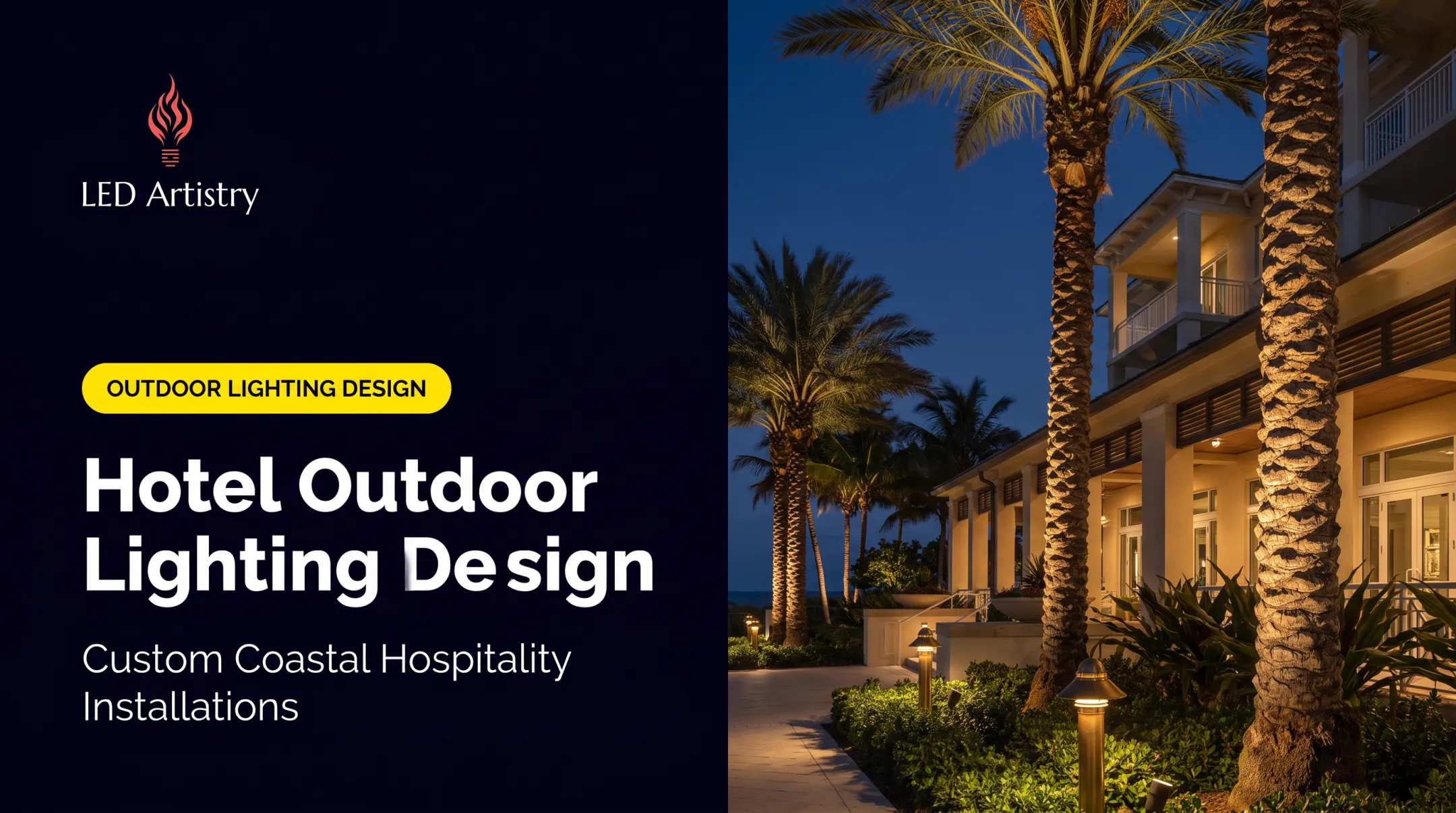
Hotels, restaurants, and HOA entrances often favor well lights because they disappear into hardscape during the day and light up walkways and entrances at night. LED Artistry prioritizes solid brass or copper for these fixtures, with 316-grade stainless steel as an alternative, targeting IP67 or IP68 ratings for moisture resistance.
Waterfront and Dock Lighting
Coastal commercial and residential properties bring their own challenges. Common configurations include:
- Recessed deck and dock lights for glare-free walking surfaces
- Piling-cap and mounted lights for edge definition and mooring assistance
- Underwater lighting (often in the 3,000–5,000 lumen range)
- Seawall and navigation lighting for boater safety
These systems typically use brass, copper, bronze, or marine-grade aluminum with sealed, gasketed housings.
Signage and Monument Lighting
Storefronts and HOA entrances depend on nighttime legibility. LED Artistry pairs backlit signage with accent lighting on surrounding palms and architecture, using targeted wall lighting so branded lettering reads clearly without overwhelming the facade. The sign should be readable from the road while the surrounding design stays coherent.
Designing for Florida's Commercial and Coastal Environment
Florida's climate is brutal on fixtures. Humidity regularly runs above 90%, salt air corrodes anything not built for it, and UV exposure breaks down finishes fast.
Standard aluminum fixtures often show deterioration within 18–24 months in coastal conditions and can fail entirely within 36 months. That's why marine-grade materials matter more here than almost anywhere else in the country.
Why Marine-Grade Housings Are Essential
- Brass and copper develop a protective patina instead of rusting or peeling
- 316-grade stainless steel resists corrosion better than standard 304-grade
- Mixed-metal assemblies need compatible fasteners to avoid galvanic corrosion, per NIST corrosion guidance
For commercial owners along Tampa Bay's waterfront, marine-grade construction separates systems that last decades from ones that need full replacement within a few years.
Those same commercial budgets also track energy use. ENERGY STAR reports that LEDs can deliver the same brightness using 90% less electricity than traditional lighting, while lasting far longer and running cooler. Treat that as a directional benchmark against your fixture choice. It still shows why commercial retrofits pencil out quickly.
LED Artistry backs its coastal installations with a 20-year warranty and ongoing maintenance service. Coastal Florida fixtures face harder conditions than a typical national install, and the coverage is built for that reality.

Low-Voltage LED Systems: The Commercial Standard
Low-voltage (12V) systems dominate commercial and architectural lighting for good reason: they're safer to work around, more flexible to install, and cheaper to run than line-voltage alternatives.
Under NEC Article 411, 12V systems fall into a distinct lighting category covering components connected to Class 2 power sources. That doesn't mean 12V is automatically permit-free everywhere. The circuit carries lower shock risk and different installation rules than a 120V run, but listed components and proper connections still matter.
Within those systems, fixture choice drives heat, energy use, and long-term operating cost.
LED vs. Halogen at Commercial Scale
At commercial scale, LED pulls ahead of halogen on every practical measure:
- LED fixtures run cooler, reducing heat stress on housings and surrounding materials
- Commercial LED retrofits commonly cut energy use by 75-80% versus halogen
- A typical 50-watt halogen fixture can often be replaced by a 7-10 watt LED equivalent
Transformer and Wire Sizing Matter More at Scale
Larger commercial properties mean longer cable runs, and that changes the math:
- Transformers should run at or below 80% of rated capacity (a 300W transformer should carry under 240W)
- 12-gauge wire works for runs up to 100 feet at 100W or less
- Runs of 100-200 feet need 10-gauge wire to manage voltage drop
- Larger properties sometimes shift to 24V systems specifically to reduce drop over distance
Getting this wrong doesn't just waste energy. It causes uneven brightness across a facade, with fixtures at the end of a run visibly dimmer than those near the transformer.
The Design-to-Installation Process for Commercial Properties
A good commercial lighting system doesn't start with fixtures. It starts with a walkthrough.
- Site consultation — Assess architectural features, entrances, parking areas, and property-specific safety concerns.
- Property mapping — Document pathways, facades, signage, and problem areas.
- Nighttime demonstration — Place temporary fixtures on-site so owners can evaluate beam spread, brightness, and color before signing off.
- Design proposal — Deliver a customized plan that incorporates feedback from the demo.
- Professional installation — Use low-impact methods, buried conduit, and waterproof connections.
- Ongoing service — Cover inspections, cleaning, realignment, and repairs.

Why the Nighttime Demo Matters
This step removes guesswork. Instead of imagining how uplighting will look on your building, you see it. You can request changes to fixture placement, beam angle, brightness, or color temperature in real time, before any permanent wiring goes in.
For restaurants, hotels, and HOAs managing high foot traffic, this preview step avoids costly rework. Once fixtures are installed and buried, adjustments get expensive fast.
Protecting the Investment Long-Term
Commercial maintenance typically runs twice yearly, with quarterly visits recommended for coastal or high-exposure sites. Standard tasks include:
- Lens cleaning and fixture realignment
- Wire inspection
- Voltage testing at the fixture (optimal range: 11.5 to 12 volts)
Skip this step and a well-designed system loses performance over two or three years.
Frequently Asked Questions
What are the current trends in exterior lighting?
Smart, app-controlled systems, tunable white fixtures, and warm color temperatures are trending in commercial and architectural design. Full-color LED options exist but are best reserved for branded scenes where the added control complexity is justified.
What is the best way to illuminate my backyard?
Layered lighting works best: ambient light for general movement, task lighting at steps or grills, and accent lighting on landscaping or pool cages. This creates depth instead of a flat, evenly-lit space.
How much does commercial outdoor lighting design typically cost?
Cost depends on property size, fixture quality, and design complexity, plus factors like coastal exposure and smart control integration. A site consultation is the best way to get an accurate quote.
Do commercial outdoor lighting installations require permits?
Low-voltage systems under 30V are generally exempt from standard permitting in Florida, but adding a dedicated 120V circuit for a transformer usually requires an electrical permit. Local codes vary, so check with your municipality.
How often does architectural or commercial lighting need maintenance?
Twice-yearly professional inspections are standard, covering lens cleaning, fixture realignment, and connection checks. Coastal or high-exposure properties often benefit from quarterly visits instead.
Can existing commercial properties retrofit LED architectural lighting?
Yes, retrofitting halogen systems to LED is common and cost-effective. Existing wiring and transformers can often be reused, and energy savings of 75-80% compared to halogen typically pay back the investment within a few years.