
The flip side is less pretty. Poorly lit steps, dark pool edges, and uneven pavers cause falls. Many homeowners simply stop using their pool deck once the sun sets because they can't see well enough to feel safe out there.
This guide covers creative lighting ideas, safety placement rules, the low-voltage technology behind it all, and how to pick an installer who won't leave you with a botched wiring job near your water feature.
Key Takeaways
- Layered lighting (ambient, task, and accent) beats flooding your deck with a single bright source
- Steps, edges, and pathway transitions need dedicated safety lighting, no exceptions
- Low-voltage LED systems (12V) are the industry standard for wet, poolside environments
- A nighttime demo before installation prevents expensive redesigns later
Creative Pool Deck Lighting Ideas for Backyard Landscapes
Recessed and Perimeter Deck Lighting
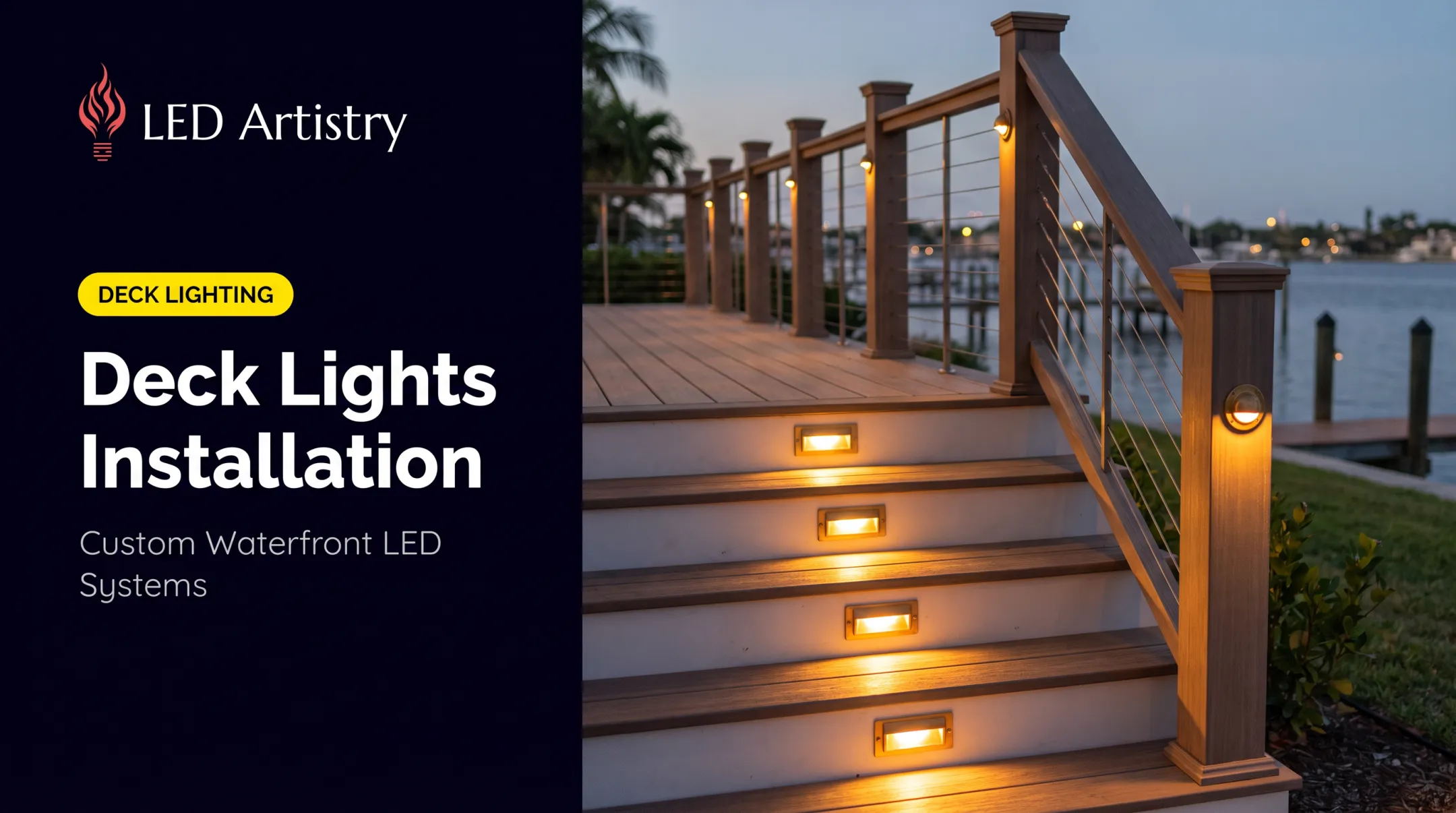
Flush-mounted fixtures along the deck's edge give you illumination without visual clutter. Low-voltage 12V LED fixtures mount directly into wood decking and work the same way on steps and elevation changes. You get a soft glow tracing the deck outline with no glare and almost no visible hardware.
Underwater and Pool-Edge LED Color
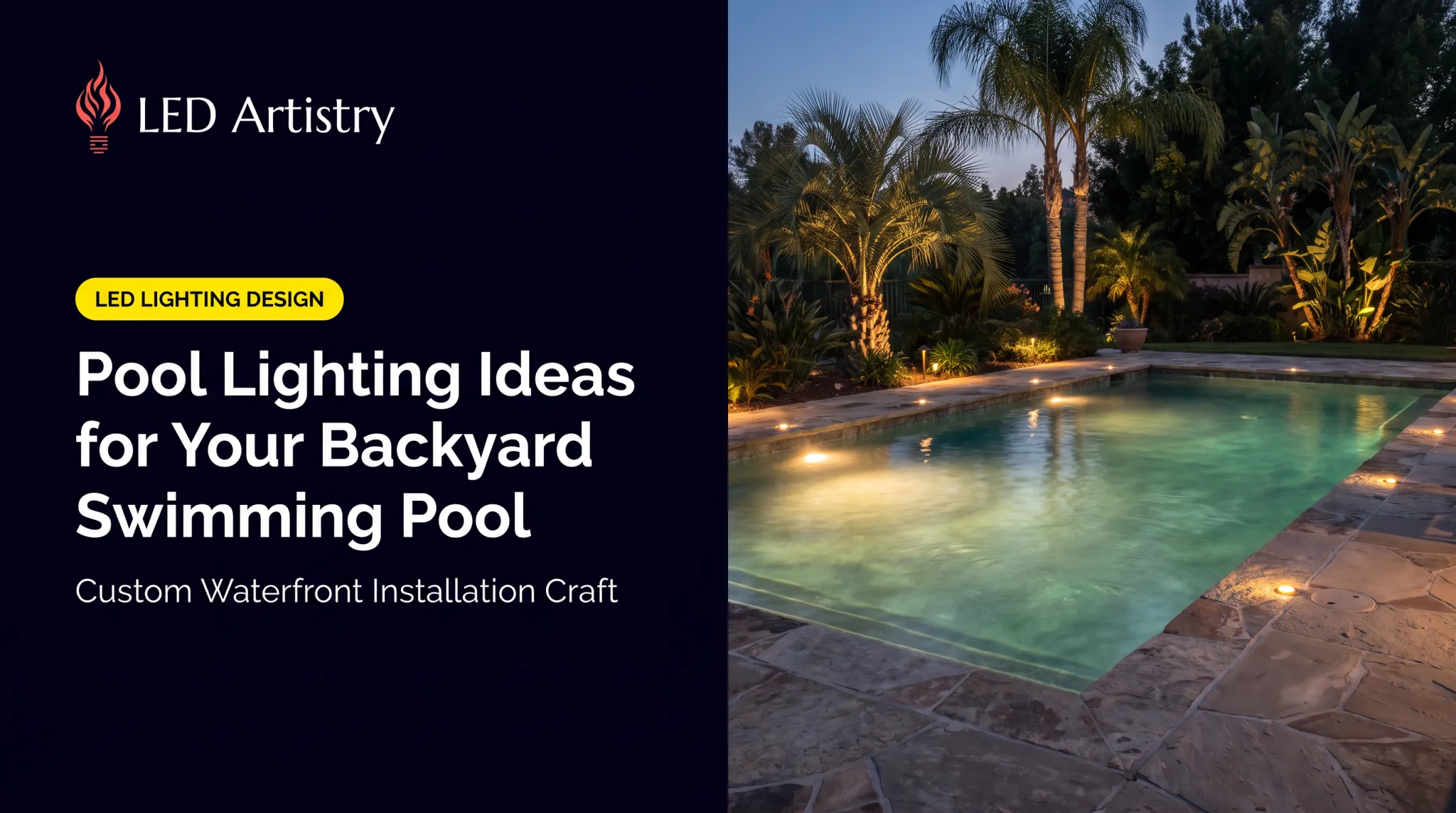
Color-changing systems near the pool edge create that resort-style glow you see in vacation photos. Dimmable, color-adjustable LEDs along the waterline and pool edge let you set brightness and hue for parties, quiet nights, or seasonal color.
LED Artistry designs and installs coordinated pool-edge and pool-cage lighting as part of a full outdoor system. Fixtures mounted inside the pool shell usually fall under the pool builder or pool electrician, so edge and cage lighting is where a landscape lighting contractor adds the most control.
String Lights, Uplighting, and Fire Accents
- String lights and lanterns — draped along railings or overhead for warmth during evening gatherings
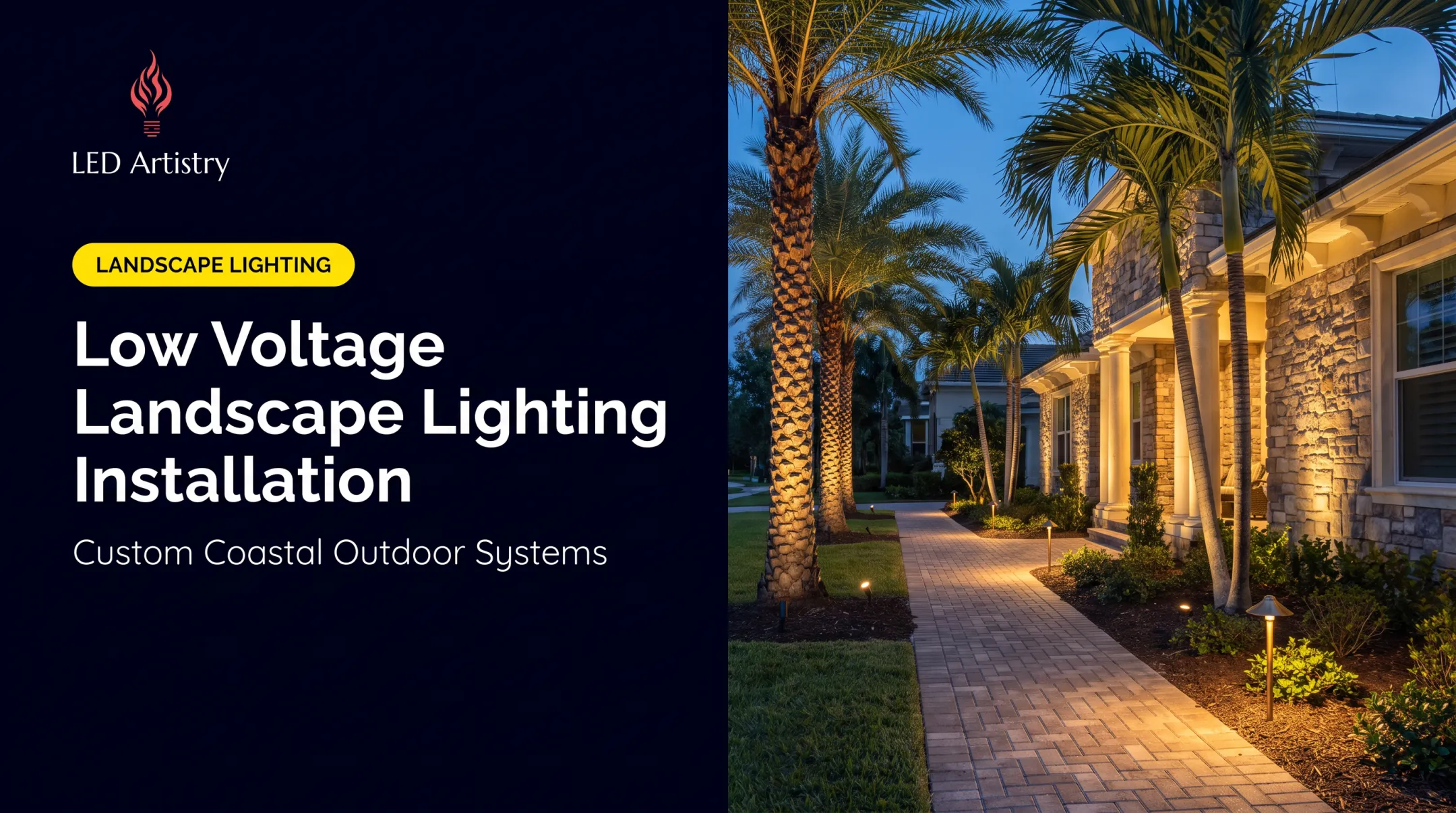
- Uplighting on palm trees and landscaping — adds depth and shadow play; narrow 10-15 degree beams work for trunks and columns, wider 35-60 degree spreads suit fuller canopies
- Fire and light combinations — fire bowls or torches paired with LED accents for tropical ambiance
- RGBW smart systems — switch moods instantly for parties, holidays, or quiet relaxation
None of these need to work alone. A deck with recessed step lights, a few uplit palms, and warm string lights overhead reads as designed, not decorated.

Above-Ground Pool Lighting Options
Above-ground pools have fewer built-in options since there's no deck structure to recess fixtures into. A permanent low-voltage layout still works well around the pool's footprint:
- Path and well lights marking the walk route to the ladder and seating areas
- Uplighting on nearby trees, palms, or screen enclosures for depth after dark
- Structure-mounted accents on fences, pergolas, or an added deck platform
- Warm perimeter string or rail lighting on a nearby structure for ambient glow
If you later add a deck or patio surround, recessed step and edge fixtures can layer in without replacing the whole system.

Strategic Placement for Safety and Ambiance
The rule of thumb: layer your lighting instead of over-lighting it. Ambient light sets the mood, task light illuminates function (steps, cooking areas), and accent light adds drama (uplit trees, architectural highlights). Skip any one layer and the space feels either flat or harsh.
Where Safety Lighting Is Non-Negotiable
- Pool steps and ladders — the single most common trip-and-fall zone
- Pool edges — where the deck meets water
- Uneven pavers or transitions — anywhere the surface changes texture or elevation
- Grass-to-hardscape transitions — easy to misjudge in the dark
Aim fixtures away from seating areas and the water's surface to avoid glare. The Illuminating Engineering Society's 2024 position statement recommends using light only where it's useful and keeping levels no brighter than necessary, a good rule for any pool deck.
Stick to a consistent 2700K-3000K color temperature across every fixture. This warm-white range, supported by DarkSky's luminaire guidelines, gives enough clarity to spot hazards without the clinical look of cooler bulbs.
LED Artistry standardizes on this same range for residential pool decks: 2700K for a candle-like glow near wood and stone, 3000K where slightly crisper definition helps around steps.
For dark corners and low-traffic edges, motion-activated fixtures add convenience and a layer of security. They're especially useful at side-yard pool access points that don't see regular foot traffic.

Low-Voltage LED Technology: The Safe Standard for Pool Areas
Poolside environments demand equipment built for wet conditions, and that starts with voltage. Under the National Electrical Code, a listed low-voltage luminaire can sit less than 5 feet from the inside pool wall only under specific conditions, including no grounding requirement and a listed transformer meeting code. That's why 12V systems, not 120V line-voltage fixtures, are the standard near water.
Understanding IP Ratings
IP ratings measure how well a fixture keeps out dust and water:
| Rating | What It Means | Pool Deck Use |
|---|---|---|
| IP65 | Dust-tight, resists water jets | Standard outdoor/damp fixtures |
| IP67 | Dust-tight, temporary immersion | Splash zones, occasional submersion |
| IP68 | Dust-tight, continuous immersion | True underwater applications only |
A waterproof LED strip rated IP65 handles rain and splashes fine, but it's not designed for submersion. Only fixtures specifically built and listed as underwater luminaires belong in the pool itself.
Materials Matter in Florida
Humidity near 90% and salt air chew through cheap aluminum fixtures fast, sometimes within 18 to 24 months. LED Artistry specifies solid marine-grade brass and copper for its systems. Those metals develop a protective patina instead of pitting or bubbling the way cheap aluminum does.

Why Professional Installation Matters
DIY pool lighting sounds simple until voltage drop, improper wiring, or fixture placement mistakes show up. Kichler's own troubleshooting guide points to voltage drop as a common failure mode, solvable only by recalculating cable gauge and transformer tap voltage. Get that math wrong near a pool and dim fixtures are the least of the problem: you create a genuine electrical hazard around water.
LED Artistry reduces that risk with a free nighttime demonstration. Technicians bring temporary fixtures to your actual property after dark, walk the grounds with you, and adjust:
- Fixture placement along steps and edges
- Beam angle and spread (narrow spots to wide floods)
- Brightness and color temperature (2700K versus 3000K)
You approve the design before any trenching or permanent wiring happens. Add a 20-year warranty and marine-grade fixtures built for Florida's coastal climate, and you skip the guesswork that often means redoing a system twice.
Maintaining Your Pool Deck Lighting System
Even well-installed systems need upkeep, especially near saltwater pools. Focus routine care on the parts salt, humidity, and hard water wear out first:
- Cleaning fixture lenses and housings of calcium and hard-water buildup
- Checking wiring and connections for corrosion
- Verifying fixture voltage (optimal range: 11.5-12 volts)
- Realigning fixtures shifted by landscaping growth
LED Artistry recommends professional inspections every six to twelve months, ideally after Florida's summer storm season when humidity and rain exposure peak. Ongoing service plans catch failing components early—before a dark stretch of deck becomes a safety or ambiance problem.
Frequently Asked Questions
What are some creative lighting ideas for a pool deck?
Recessed deck lights, string lights over gathering areas, and uplighting on nearby trees create a strong base layer. Add color-changing RGBW accents near the pool edge for a resort-style finish.
What is the rule of thumb for outdoor lighting?
Layer ambient, task, and accent lighting rather than relying on one bright source. This avoids harsh glare while still covering safety zones like steps and edges.
What are some good lights to put around an above-ground pool?
Clip-on LED lights, portable lanterns, and low-voltage path lights along the perimeter work well when there’s no built-in deck structure. Surface-mounted fixtures on nearby posts or fencing are another solid option.
Are waterproof LED strips safe for pools?
Waterproof strips rated IP65 or IP67 handle rain and splashes but aren't safe for submersion. Only fixtures specifically listed for underwater use should go inside the pool itself.
How much does professional pool deck lighting installation cost?
Cost depends on fixture count, deck size, wiring complexity, and system features like smart controls or color-changing capability. Request a free on-site nighttime demo and quote for accurate pricing.
Can pool deck lighting be added to an existing landscape lighting system?
In most cases, yes. If your transformer has spare capacity, technicians can split circuits into new zones or run additional low-voltage wire without a full system redesign.